
SEOUL, IN PETER’S WORDS · Palaces & history
Five hundred years of the Joseon Dynasty in Seoul
The city moves. The palace walls hold their ground.
Peter N. Liptak · Original guidebook essay, with dated editorial updates
Read the essay ↓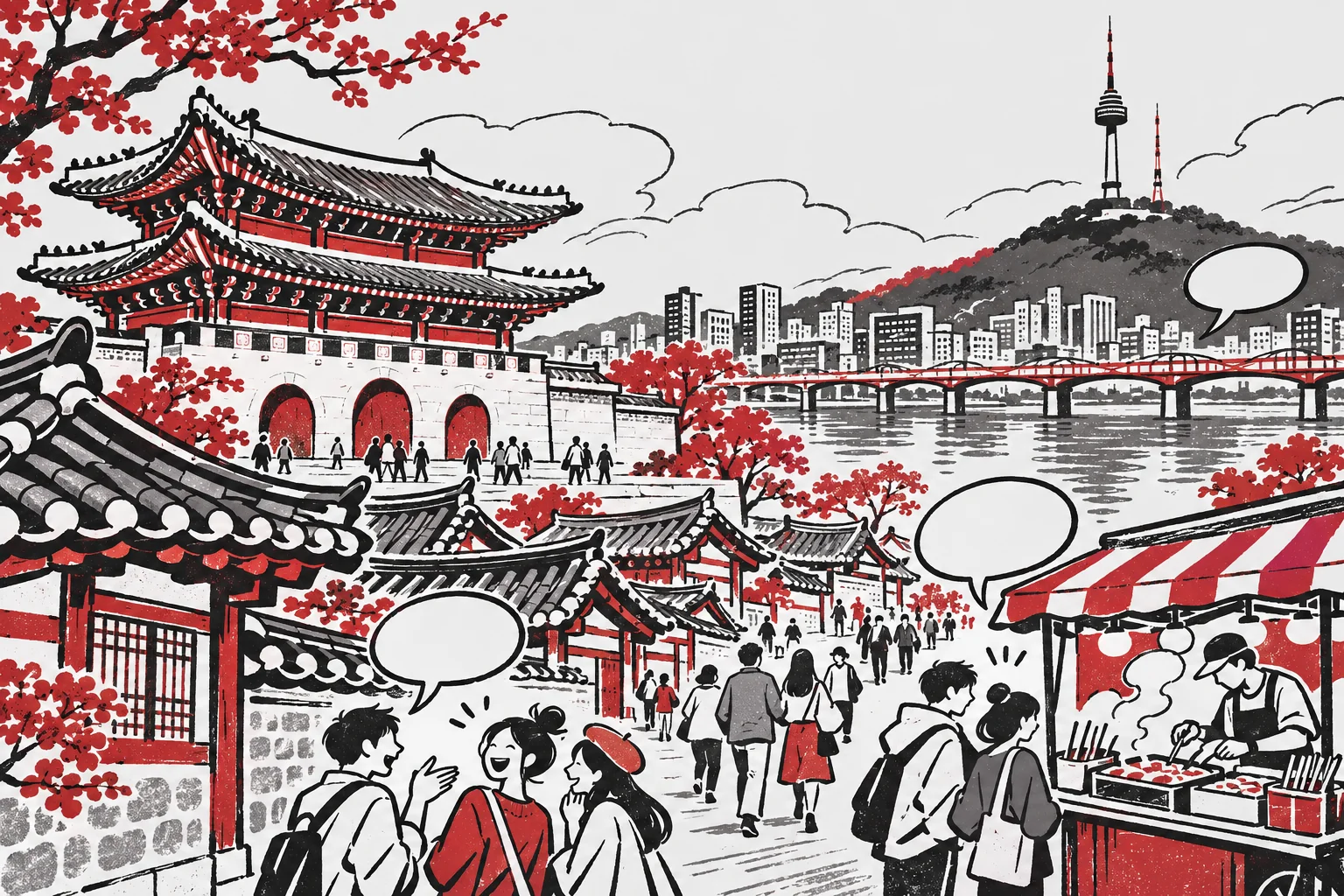
THE ORIGINAL ESSAY
At Seoul’s heart is a cityscape filled with life, yet it is also home to a host of palaces scattered throughout its urban center, vestiges of the last kingdom of Korea, the Joseon Dynasty (1392-1910). Seoul was its capital during the five-hundred-year reign and has remained the capital of the Republic of Korea though 100 years have passed since the fall of the dynasty. As such, it is only natural that the palaces of Seoul exhibit the essence and aesthetics of Korean architecture.
Gyeongbok Palace is the oldest among them and also the dynasty’s main palace. A view from Sejongno Street’s Sejong Center for Performing Arts puts the panorama of nature, history and modernity into perspective with Gyeongbok’s main gate taking center stage, the peak of Mt. Inwang as a backdrop, and the bustle of the city in the foreground. The palace’s place within the landscape of Seoul is nothing short of magnificent. Similarly, sitting on a bench in the spacious garden in front of Gyeonghoeru, one of the palace’s many buildings, and appreciating its architectural aesthetic allows one to become totally immersed in the atmosphere of the season. Yangwonjeong, in the rear of the palace, offers a cozy atmosphere and autumn, when the leaves of the ginkgoes turn the scene yellow, is the best time to visit. Gyeongbok Palace is also home to the National Folk Museum and the National Palace Museum, making it a must-see for anyone who is interested in Korea’s cultural relics.
The rotation ceremony of gatekeepers at Deoksu Palace, a palace that stands directly across from Seoul City Hall and Seoul Square, is held three times a day except Mondays. When the guard, clad in yellow, first arrives in front of the gate, they strike their drums and gungs to stir the crowd as people close in on Daehanmun square. Following the ceremony, you can take a photo with the gatekeepers.
The beauty of Korean palaces lies in the harmony of their buildings with nature. As seen in the rear garden of Deoksu Palace, a fine balance is struck in a truly Korean way. Any tour of Seoul should start in its palaces, where manmade beauty retains its rapport with nature.
From Peter’s supplied Seoul guidebook introduction, chapter 1. Original observations and historical framing are retained. PDF line-break and spacing repairs are recorded separately from factual updates. Guidebook photography and venue directories are not republished.
TAKE THE LANGUAGE WITH YOU
A city is a conversation, too.
Follow a related expression into its illustrated meaning and bilingual scene. These are informal book-sourced expressions, not a script to use with every stranger or service worker.
말 까다speak plainly; dispense with the nicetiesRead the book-sourced scene →Keep the whole conversation.
Keep the illustrated expressions, bilingual conversations and cultural notes together in As Much as a Rat’s Tail.
As an Amazon Associate I earn from qualifying purchases. Amazon handles regional availability and matching.
Another side of Seoul
Seoul experienced through museums
A city’s past is more interesting when you can stand in front of it.
Experience traditional culture in Namsangol Hanok Village
A little breathing room, just beyond the traffic.
An experience in temple life
Seoul has a volume control. Sometimes you find it in a temple courtyard.