

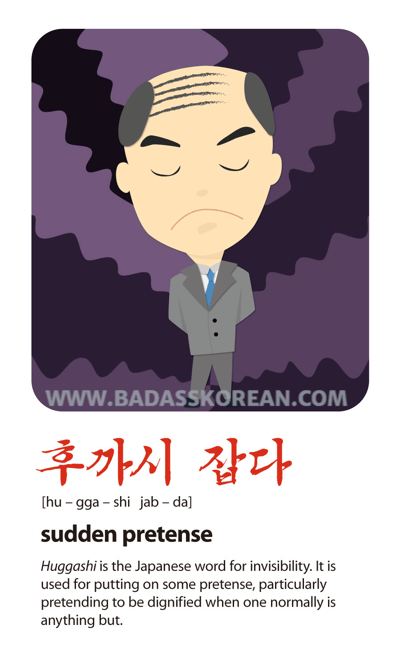
후까시 잡다
[hu-gga-shi jab-da]
sudden pretense
The Flashcard
The original illustrated card, front and back.

Meaning & context
후까시는 일본말로서 ‘눈으로 볼 수 없음을 의미’한다. 여기서 이는 어떤 겉치레하는 것을 의미하여, 특별히 위엄있는 척을 할 경우 사용된다.
Huggashi [후가시] is the Japanese word for invisibility (or as a verb, to show off), and japta [잡다] is Korean for to seize or grab. In essence, it means to grab at the unattainable or putting on some pretense, particularly pretending to be dignified when one normally is anything but. Similar to the English expression “cop an attitude,” in particular, for an overly competitive person, or even someone who coifs their hair high or wears risers in their shoes to make themselves look taller.
From As Much as a Rat’s Tail · book pages 230–231. Original published text; historical references and usage are retained.
STORY TIME
See it in conversation
Korean
점잔빼는 말
English
Proper Fucking Language
(통화중) 예, 알겠습니다. 감사합니다… 아닙니다. 확실히 하겠습니다.
(on phone) Ah, Yes sir, thank you sir… No, sir. Yes, I certainly will, sir.
뭐하는거야? 너 존댓말 절대 안쓰잖아. 누구때문에 후까시 잡는건데?
What? You never use polite language. For whom is this huggashi jabda?
직장 상사랑 전화하느라고 그런거야. 근데 니가 어떻게 아냐? 너 존댓말 한 글자도 모르잖아.
Just talking to my superior officer. And how do you know? You don’t even know any formal language.
알지 왜몰라... 후까시 잡기 싫어서 그러는것 뿐이지. 난 편안하게 대화하고 싶다고. 난 격식따위에 신경쓰지 않으니까.
Of course I do. . . I just don’t like to huggashi jabda. I like to speak comfortably. I’m full of informality.
물론 그러시겠죠. 머리에 똥만 차가지고!
You’re full of something all right!
From the book: notes & culture
Culturally Speaking
Sir, Yes Sir!
Languages are defined by culture; this is particularly true for Korean as Honorifics in the language are dictated by the situation or relationship of the people communicating. With different words and structures used for people that are older or more senior in some position or for public speaking (높은말 [nop-in-mal] high-formal language), peers of the same age or same level in the work environment (존댓말 [jon-daet-mal] polite informal), and those of lower age or position (반말 [ban-mal] informal). Many non-native speakers find it difficult to understand or at least get used the sometimes complicated language, particularly of the marked differences of language of a news program vs. the conversations one has with peers. Additionally, the rapid changes necessary in a conversation of mixed levels. Finally, banmal can be used with someone that should be spoken to with formal or polite language to deliberately insult them. (This too often happens to foreigners in Korea who might not catch the insult.)
TAKE THE WHOLE BOOK WITH YOU
As Much as a Rat’s Tail
Illustrated Korean, bilingual conversations, and the stories behind the expressions. Read here, then keep the complete book close.
Find the book Korean for lovers →