

The Flashcard
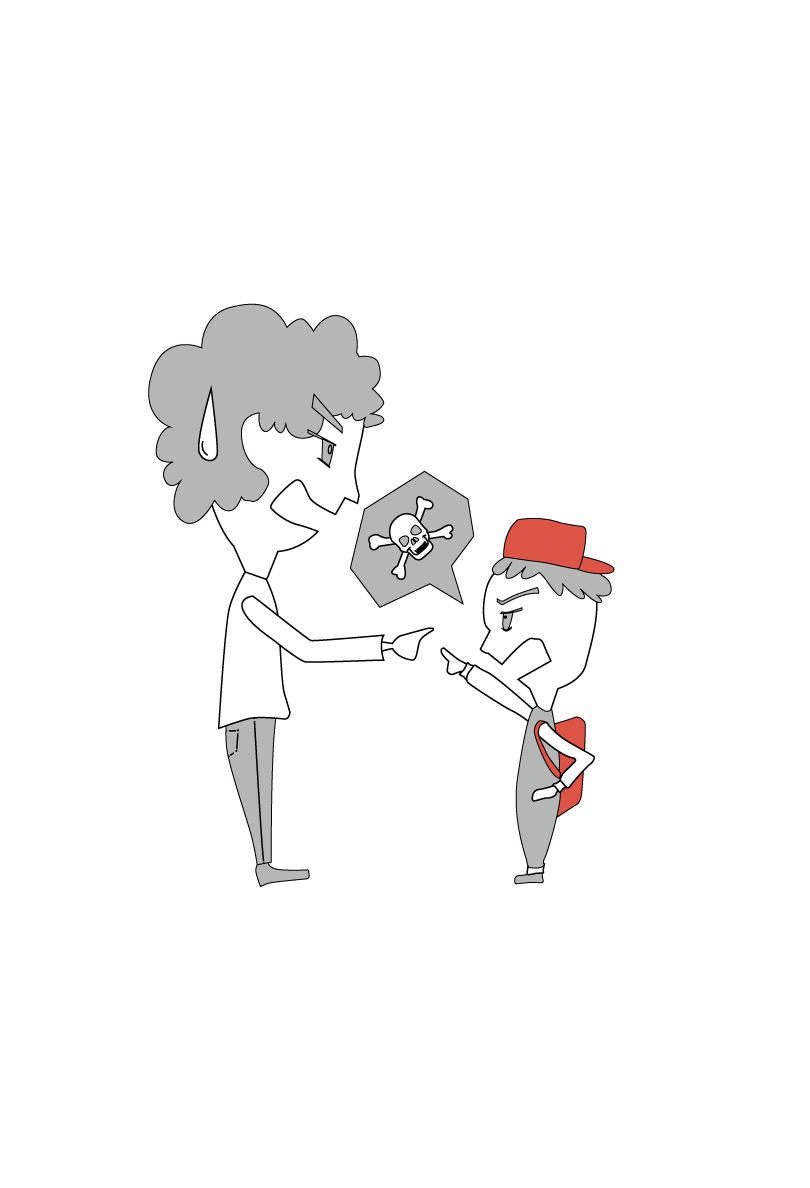
The original illustrated card, front and back.

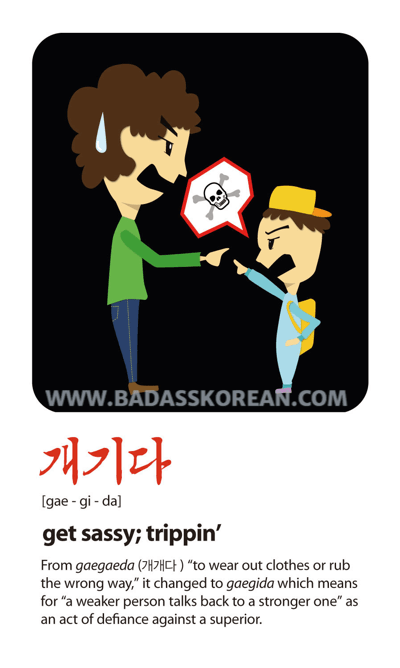
Meaning & context
본래 닳거나 해지다, 성가시게 달라붙다라는 의미를 가지고 있는 ‘개개다’라는 단어로부터 변형된 말. 여기서는 자신보다 힘이 센, 더 높은 위치에 있는 사람에게 대들거나 반항하는 모습을 이르는 말로 설명하고자 한다.
From the original gaegaeda (개개다), to wear out clothes or to rub the wrong way, as with annoying someone by tagging along, this changed to gaegida with the meaning of picking a fight (used when a weaker person talks back to a stronger one) as if an act of rebelling against one’s master. Similar to “get smart with” or “sass” someone. Also: 하극상 [ha-gug-sang] defy an order (in the army); mutiny
From As Much as a Rat’s Tail · book pages 16–17. Original published text; historical references and usage are retained.
STORY TIME
See it in conversation
Korean
불쌍한 참새
English
Poor Sparrow
로빈아! 매점가서 컵라면 사와!
Robin-a. Go get me a cup-ramyon from the school store.
귀찮아. 넌 손이 없어? 발이 없어? 네가 직접 사먹어.
How annoying. You don’t have hands? No feet? You go buy it and eat it yourself.
개기는거야? 그렇게 개기다가 한대 맞는다.
You gaegida me? If you gaegida like this, I’ll smack you.
나 때리면, 다음 시험 때 누구 시험지 베끼려고 그래?
If you hit me, whose test will you copy off of next time?
From the book: notes & culture
The Straight Scoop
To call someone neoiga (네가) is the lowest form of ‘you’ and would be offensive to someone older. The ‘-a’ (아), -ya (-야) or -i (-이) ending on a name is a diminutive of familiarity similar to the French -ette.
Culturally Speaking
Yakety, Yak. Don’t Talk Back
Establishing hierarchy in even relationships is common in Korea as strict hierarchical systems and Confucian values are the norm. This is often true even among peers within the same group with some member establishing themselves as the leader or alpha and expecting others to do their bidding. At times this can resemble a mafia-like structure and is often associated with bullying in school .
A big bowl of Rice
%
Jjang-Heol-Gwang

RAT RATING
Quote of the Day
“누가 말할 수 있다고 그래서? 앉고, 입닫고, 개기지마!”
“Who said you could speak. Sit down, shut up and stop talking back!” ~ Getting one’s hair up (in arms)
Back talk and you’ll get back handed… Yakety, Yak. Don’t Talk Back
TAKE THE WHOLE BOOK WITH YOU
As Much as a Rat’s Tail
Illustrated Korean, bilingual conversations, and the stories behind the expressions. Read here, then keep the complete book close.
Find the book Korean for lovers →