

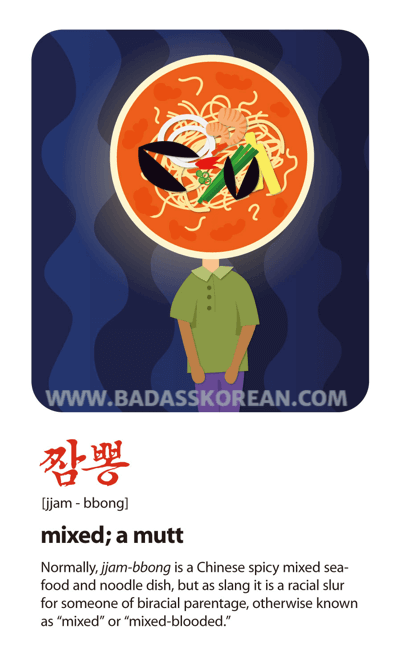
짬뽕
[jjam-bbong]
historical derogatory usage about mixed ancestry
The Flashcard
The original illustrated card, front and back.

Before you use it
The historical slang sense shown here is a racial slur. The card also names a noodle dish; this slang sense is offensive when applied to a person.
Meaning & context
보통, 짬뽕이라고 하면 매운 해물이 섞여있는 국수를 뜻한다. 그러나 비속어로서의 이것은 혼혈인을 뜻하게 된다. 이것은 경멸적인 용어로 다른 인종과의 혼혈을 보고 한국인들이 사 용하는 표현이다.
Normally, jjambbong is a spicy mixed seafood and noodle dish available at Korean style Chinese restaurants and as slang can be used for anything that is mixed. It is however, often used as to belittle someone of mixed racial heritage, and in particular for biracial Koreans. Depending on the tone, it’s connotation can range from simply insensitive to disparaging or a racial slur.
From As Much as a Rat’s Tail · book pages 196–197. Original published text; historical references and usage are retained.
STORY TIME
See it in conversation
Korean
섞인 축복
English
A Mixed Blessing
그 소식 들었어? 승만이가 외국인이랑 결혼했대!
Did you hear the news? Seungman married a foreigner!
어, 그 여자 오스트리아 귀족이래.
Yeah, I hear she’s an Austrian aristocrat.
근데, 아이들은 어쩌니? 걔네는 짬뽕 일거야!
But what if they have kids? They’ll be jjambbong!
애들은 분명히 이쁠거야. 지금이 니 생각과 마음을 고쳐먹을 때야.
I bet they’ll be beautiful. Maybe it’s time you opened up your mind… and your heart.
From the book: notes & culture
More ‘Mixed’ Metaphors
튀기 [tui-gi] of mixed blood, a mongrel or half-breed (originally a crossbreed of a donkey and a cow and extremely offensive).
혼혈아[hon-hyeol-a] a child of mixed racial origins. While commonly used in Korea and not pejorative, it’s English equivalent (mixed) would be somewhat rude or even offensive to some (better to say 1/2 Korean or of biracial parentage).
Intolerance, Prejudice &
Xenophobia... Oh my!
Racial Epithets for the Ethnically Unempathetic
DO NOT USE!
Despite the fact that Korea has people of many ethnic backgrounds, and has intermixed with the Chinese, Japanese, and Mongolians throughout its long history, some continue to look down on others. People of mixed blood have historically been subjected to beating and ridicule (especially in schools), and though this attitude is becoming less and less common in recent years, there is still an element that is too intolerant to other ethnicities.
•외국놈 [oi-gug-nom] foreign bastard (derogatory for any non-native)
•쪽바리 [jjog-ba-ri] an ethnic slur for a Japanese person, like “Jap”
•양키 [yang-ki] or 양놈 [yang-nom] yankee bastard or fuckin’ westerner
•미국놈[mi-gug-nom] an American bastard
•코쟁이 [ko-jang-i] a (big) nosed fanatic – meaning Westerner (like cracker)
•깜둥이 [ggam-deung-i] black one (similar to the offensive English, nigger)
•검둥이 [geom-deung-i] black one (not quite as offensive as ggamdeungi)
•사악한 검은 원숭이 [bbal-gang-i] a wicked black monkey, recently used in a North Korean press release to describe president Obama.
•짱깨 [jjang-ggae] pejorative for a Chinese person, similar to “chink” as it relates to the Korean Chinese dish 자장면 [ja-jjang-myeon], or a jajangmyun delivery man, which is considered a very low position.
•빨갱이 [bbal-gang-i] fuckin’ commie (derogatory for a North Korean) (Though we catalog these insults and epithets here, we only do so in the interest of understanding, in the potential offered by a complete education of both the good and bad, and in hopes that you will never use them yourself.)
TAKE THE WHOLE BOOK WITH YOU
As Much as a Rat’s Tail
Illustrated Korean, bilingual conversations, and the stories behind the expressions. Read here, then keep the complete book close.
Find the book Korean for lovers →