

입이 싸다
[ib-i ssa-da]
loose-tongued; can’t keep a secret; a blabbermouth
The Flashcard
The original illustrated card, front and back.

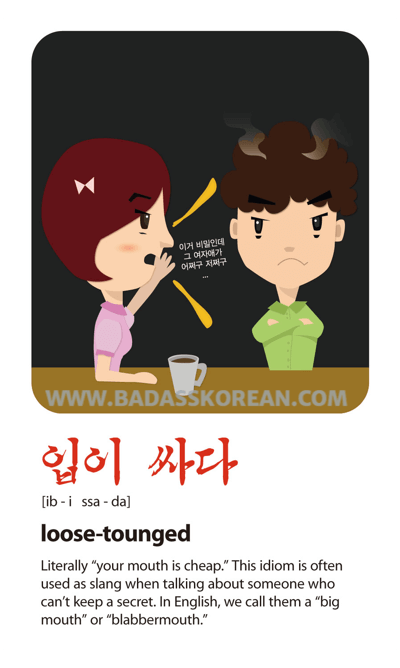
Meaning & context
비속어로 자주 쓰이는 관용어로서, 글자 그대로 풀이하면 입이 싸다라는 뜻. 입이 가벼워 비밀을 지키지 않는 것으로 비슷한 영어표현으로는 “loose tongued”가 있다.
Literally “your mouth is cheap.” This expression is often used as slang when talking about someone who can’t keep a secret. Some American English synonyms would be “a big mouth” or “a gossip monger,” but its closest equivalent is “loose tongued.”
From As Much as a Rat’s Tail · book pages 178–179. Original published text; historical references and usage are retained.
STORY TIME
See it in conversation
Korean
숨은 뜻
English
The Subtext
여보세요.
Hello.
응... [어...]
Eung . . . [Yes . . .]
너 왜 그렇게 입이 싸?!
Why are you so ibi ssa?!
으? [무슨 소리야?]
Uh? [What do you mean?]
내 새 남자친구한테 코 고친거 다 말했잖아... 입이 싼 년!
You told my new boyfriend about my nose job. . . You ibi ssan bitch!
음. [어. 그랬지 – 그래서 어쩌라고?]
Mm. [Yep. I did – and so what?]
걔 고친 여자 싫어한다면서 나 버렸단 말이야!!
He said he hates girls that have been cut and he dumped me!!
응, 흠. 끊어. [어, 니 등에 칼 꽂았다 이년아! 그래서 뭐. 안녕.]
Eung. Hm. Geunneo. [Yep, I’m a backstabbing bitch! So what. Bye.]
From the book: notes & culture
Korean Phone Language
and Etiquette
•여보세요 [yo-bo-sae-yo] hello on the phone. Literally means “look here,” and sounds to foreigners like “excuse me?” as if it means “why are you bothering me?” but it just means hello.
•어디세요 [o-di-sae-yo] literally “where are you,” but actually means what company are you calling from, who are you, or for what reason are you calling. This is most often used at a place of business.
•끊어 [geunh-eo] literally meaning “cut off.” This curt expression is used to finish a conversation and effectively say goodbye on the phone.
The Odd Sounds
of a Cellphone
•어 [uh] a lazyman’s “yes.” An affirmation similar to the English mmm. Some Koreans will answer their mobile phone and have an entire conversation with only this word, then end with the terse geunheo (끊어).
•There are many variations: 응, 으, 음, 흠 [eung, eu, eum, heum]. These sounds are all used similarly to carry on a conversation without actually saying anything. The various meanings can be inferred from the intonation. 1. These sounds can be slightly altered to fain cuteness (only used by girls), as in 앙, 웅, 힝 [ang, ung, hing] or the longer 우우우웅 [u-u-u-ung]. 2. It may also show that the speaker doesn’t have much interest in talking. 3. It is very common among cheaters or just as a way to avoid saying anything that might be heard by others around you (read – 양다리 [yang-dari] two-timing cheaters). 4. It can also be used to simply indicate that you are still listening to the speaker, though maybe not so actively engaged in the conversation.
•콜 [uh] a quick and clear affirmation similar to “sure” or “you bet.” (Can be used in person as well.)
TAKE THE WHOLE BOOK WITH YOU
As Much as a Rat’s Tail
Illustrated Korean, bilingual conversations, and the stories behind the expressions. Read here, then keep the complete book close.
Find the book Korean for lovers →