

따 왕따 은따 전따
[dda (wang-dda, eun-dda, jeon-dda)]
a black sheep; a loser, loner or reject
The Flashcard
The original illustrated card, front and back.

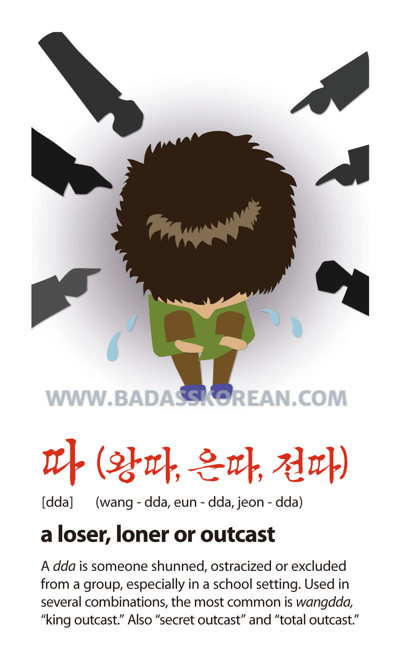
Meaning & context
그룹 내에서 심하게 따돌림을 당하거나 외면 당하는 사람을 의미하는 말이다. 특히 학교에 서 주로 사용되는 표현. 따는 여러가지 조합으로 사용되어지는데, 가장 일반적인것은 왕 따, 반에서 가장 소외당하는 학생을 의미한다. 은따는 그들 스스로 인기있다고 생각하지만 실제로는 은근히 따돌림 당하고 있는 학생을 의미하고, 전따는 교내 전체에서 가장 따돌림 받는 아이를 말한다.
Someone who is shunned, ostracized or excluded from a group, especially in a school setting. Dda can be used in several combinations, the most common is wangdda [literally “king outcast”] for the most shunned student in a class; Eundda [“secretively outcast”] refers to someone who thinks they are popular, but are widely disliked; and jeondda [“total outcast”] the biggest pariah in the entire school. Also: 루저 [ru-jeo] a loser (mostly about appearance); esthetically challenged
From As Much as a Rat’s Tail · book pages 92–93. Original published text; historical references and usage are retained.
STORY TIME
See it in conversation
Korean
은에서 금으로
English
Silver to Gold
빌, 너 왕따지, 아니야? 내가 너 빵셔틀 당하는거 봤어.
Bill, you’re a wangdda, aren’t you? I saw you have been doing the bread shuttle.
좆까! 난 공부 잘해서 애들이 좋아해!
Hell no! I’m admired for my good grades!
하하. 그러면 너 은따겠지.
Ha ha. Then you must be an eundda.
진짜래도 스티브, 나 인기도 많고 똑똑하잖아.
Really Steve, I’m popular and smart.
내가 따일수도 있지만, 넌 진짜 전따야.
Maybe I’m a dda too, but you really are a chundda.
Gates! Jobs! 따 새끼들, 체육수업으로 돌아가 안그러면 머리박는다.
Gates! Jobs! You dda SOBs get back to gym class or else you’ll be on your heads.
From the book: notes & culture
Corporal Punishment
The Serious Suffering of School Sanctions ㄷ
Corporal punishment was still commonplace in schools and the military in Korea until recently. It is becoming less and less acceptable, though it is still used upon occasion to discipline students.
•머리박다 [meor-i-bak-da] Literally “to beat your head.” Originally from the military, meoribakda is a form of punishment where you put your head on the ground with your arms behind your back and your legs spread to form a tripod. Teachers will make delinquent male students assume this acutely uncomfortable, painful position as a potent reminder to obey. A prime example can be seen in the movie Chingu (친구). Thanks Teach!! Other forms of punishment
•손 들기 [son deul-gi] standing with one’s arms raised (also a common punishment of young children by their parents).
•오리 걸음 [or-i gyeor-eum] walking like a duck.
•앉았다 일어나기 [anj-at-da il-eo-na-da] doing (an excessive amount of) squats.
•책으로 학생 머리 때리기 [chaeg-eu-ro hak-saeng meo-ri ddae-ri-gi] hitting a student’s head with a book. OUCH!
The Straight Scoop
빵셔틀 [bbang-sheo-tel] literally “bread shuttle.” A bangsheotel is a student who is belittled or bullied into a kind of servitude, like a “trained seal” to run errands for other stronger or more senior peers.
TAKE THE WHOLE BOOK WITH YOU
As Much as a Rat’s Tail
Illustrated Korean, bilingual conversations, and the stories behind the expressions. Read here, then keep the complete book close.
Find the book Korean for lovers →