

돌싱
[dol-sing]
single and ready to mingle; a divorcée
The Flashcard
The original illustrated card, front and back.

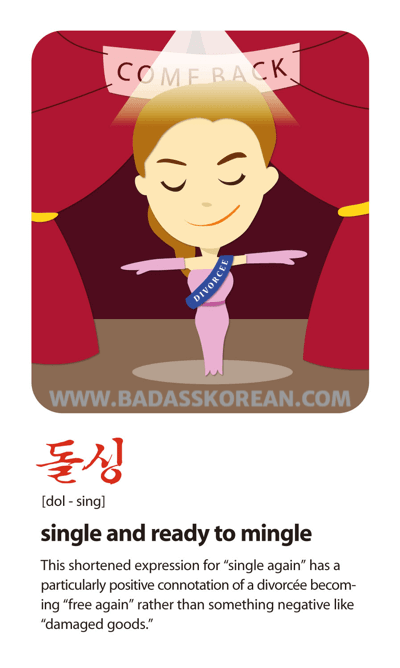
Meaning & context
“돌”은 돌아온, 그리고 “싱”은 싱글의 줄임말로 돌아온 싱글을 의미한다. 이 줄임 표현은 “실패자(Damaged goods)”라는 부정적 의미보다는, “다시 자유”라는 특히 긍정적인 의
미를 함축하고 있다. 이 표현은 한국에서의 이혼율 증가와 더불어 이혼에 대한 부정적 태 도가 줄어들며 생겨나게 되었다.
Dol (돌) from the Korean dol-a-un (돌아온), or returned, and sing, (싱) for newly single (돌아온 싱글). This abbreviated expression has a particularly positive connotation of “free again” rather than something negative like “damaged goods.” Dolsing has come about in recent years with the growing number of divorces in Korea and the lessening of critical attitudes toward divorce.
From As Much as a Rat’s Tail · book pages 82–83. Original published text; historical references and usage are retained.
STORY TIME
See it in conversation
Korean
돌싱반찬의 고백
English
Confessions of a Dol-Sing Side Dish
오빠, 나 더 이상은 못 기다리겠어… 언제 프로포즈 할거야?
Oppa, I’m not going to be hot forever… When are you going to propose?
음, 우선 너한테 한 가지 중요한 얘기 할게 있어.
Well, I have to tell you something important first.
뭔데?! 오빠 엄마가 나 안 좋대?
What?! Your mother doesn’t like me?
아니, 아니야! 엄마는 You(Ja), 너를 정말 좋아해…
No, no! She loves You(Ja)….
그럼 뭔데?.
Then what?
어, 나 돌싱이야… 많이 화났지?
Uh, I’m a dolsing… Are you mad?
뭐? 어떤 여자야? 설마 그 매춘부 율무는 아니겠지?!
What? Who was she? Not that harlot YulMu?.
아니, 아니야… 그녀 이름은 치…. 성은 김씨고.
No, no… her name was Chi…. From the Kim clan.
뭐?! 김치와 결혼했었다고? 무슨 일이 있었던 거야?
What?! You were married to KimChi? What happened?
그냥 쉬어버렸어.
It just went sour.
From the book: notes & culture
The Straight Scoop
유자 (yu-ja) & 율무 (yul-mu) – YouJa and YulMu are kinds of tea that we have turned into names for the pure purpose of ‘hot liquid’ personification. 김치 (kimchi), though not a liquid is hot in it’s own way! Rawr Ms. Kim!
Truncated Terms
The CCEB (Commonly Condensed Expressions Box)
•깜놀[ggam-nol] – 깜짝 놀랐다 a sudden shock; a fright
•돌싱[dol-sing] – 돌아온 싱글a return to singledom
•멘붕[maen-bong] – 멘탈붕괴 a mental breakdown or collapse (often used by students for stress from excessive studying at test time.)
•안물 [an-mul] from 안물어봤어 meaning I didn’t ask you. So what?
•엄친아 [eom-chin-ah] from 엄마 친구 아들, literally “my mom’s friend’s son.” This is for highly competitive mothers to compare their child to someone who is good looking, highly successful and rich).
•행쇼[haeng sho] from 행복하십쇼, have a good day; don’t worry, be happy
TAKE THE WHOLE BOOK WITH YOU
As Much as a Rat’s Tail
Illustrated Korean, bilingual conversations, and the stories behind the expressions. Read here, then keep the complete book close.
Find the book Korean for lovers →